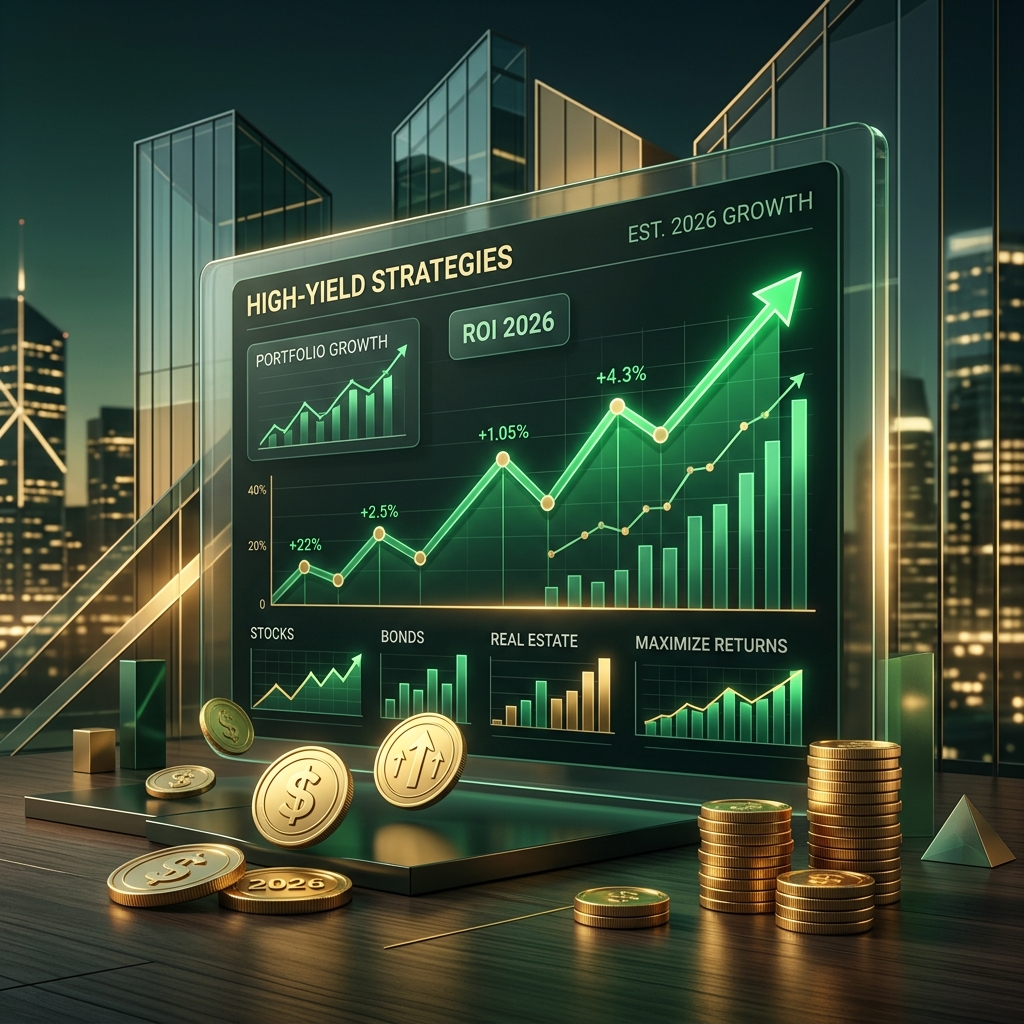
In a world of fluctuating inflation and rapid technological change, letting your savings sit in a traditional bank account is essentially losing money. In 2026, the secret to building wealth isn't just "saving"—it's "smart deployment." With interest rates stabilizing after the volatility of the mid-2020s, new opportunities for high-yield returns have emerged for those who know where to look.
This guide breaks down the most effective high-yield investment strategies for 2026, balancing the desire for high returns with the necessity of risk management. From traditional dividend stocks to fractional real estate, here is how you can maximize your portfolio this year.
1. Why 2026 is a Unique Year for Investors
2026 marks the beginning of the "Post-AI Integration" economy. Many companies that spent billions on AI in 2024 and 2025 are now seeing massive efficiency gains reflected in their bottom lines. This is leading to a resurgence in corporate profits and, subsequently, higher dividend payouts.
- Stabilized Interest Rates: Central banks have settled into a "new normal," making fixed-income assets predictable again.
- Energy Transition: Renewables are now profitable without heavy subsidies, creating high-yield "green" opportunities.
- Decentralized Finance (DeFi) Maturity: DeFi has moved from "wild west" to "regulated innovation," offering yields far above traditional banks.
In 2026, "Cash is King" again—but only if that cash is in a High-Yield Savings Account (HYSA) or a Money Market Fund. Avoid keeping more than 3 months of expenses in a standard checking account.
2. High-Yield Asset Class Comparison
| Strategy | Expected Yield | Risk Level | Liquidity |
|---|---|---|---|
| Dividend Aristocrats | 3% - 6% | Low | High |
| Real Estate (REITs) | 5% - 9% | Medium | High |
| Corporate Bonds | 4% - 7% | Low/Medium | Medium |
| Staking (Stablecoins) | 6% - 12% | High | High |
3. The Power of Dividend Growth Stocks
Investors often chase the highest yield, but the smartest money chases Dividend Growth. Companies that consistently increase their dividends year-over-year prove their financial health. In 2026, look for sectors like healthcare and consumer staples, which remain resilient even in economic shifts.
Use our Percentage Calculator to determine your "Yield on Cost" over time. This metric is the true indicator of long-term wealth generation.
4. Fractional Real Estate: The New Gold Mine
You no longer need $500,000 to invest in real estate. Platforms in 2026 allow you to buy "fractions" of commercial and residential properties for as little as $100. This provides the monthly rental income of a landlord without the headache of fixing toilets or chasing tenants.
5. Tech-Driven Growth: Beyond the AI Hype
While AI is a huge driver, don't ignore Cybersecurity and Biotech. As our lives move further online, the companies protecting that data are becoming the "Utility Companies" of the 21st century. These aren't just growth plays anymore; many have started paying significant dividends.
6. The "Safety First" Risk Management Framework
High yield always comes with risk. To invest safely in 2026, follow the **70/20/10 Rule**:
- 70% Core: Low-cost index funds and blue-chip dividend stocks.
- 20% Growth: Tech stocks, emerging markets, and REITs.
- 10% Speculative: Crypto, startups, and high-yield corporate bonds.
7. Frequently Asked Questions
Conclusion: Start Your Wealth Journey
The road to financial freedom is paved with consistent, smart decisions. By diversifying into high-yield assets and maintaining a long-term perspective, you can navigate the complexities of 2026 with confidence. Remember, the goal isn't just to make money—it's to make your money work for you.
Calculate your potential growth today with our suite of Math Tools and take the first step towards a wealthier future!